
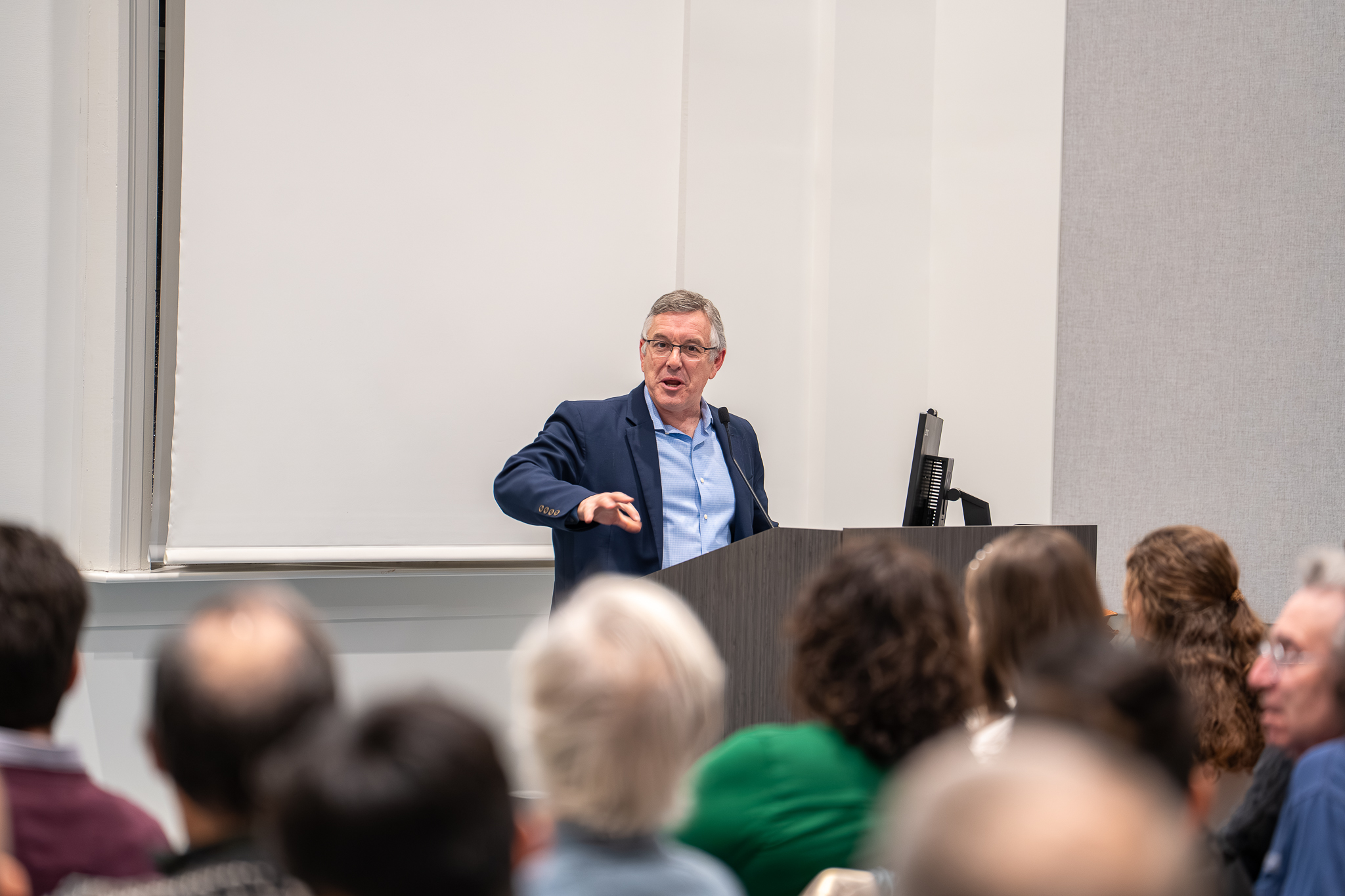
On December 2, 2025, CEVIHE co-sponsored an event with the Jonathan M. Tisch College of Civic Life featuring guest speaker Colin Woodard. Woodard, a Tufts alumnus, A91, and bestselling author, directs the Nationhood Lab at the Pell Center for International Relations and Public Policy at Salve Regina University. In addition to his recent book, Nations Apart: How Clashing Regional Cultures Shattered America (Viking Books, 2025), he has reported from more than fifty countries as a foreign correspondent and investigative journalist. During the event, Woodard discussed the central question of his new book: how have centuries-old regional differences brought American democracy to the brink of collapse?
Woodard began by describing the blueprint on which the United States was built. Rather than a single, unified nation-state, he argued, the United States is better understood as a federation of distinct regional “stateless nations,” each with its own cultural values, political traditions, and historical memory dating back to colonial settlement patterns. As he explained, “We’re a collection of stateless nations, each with their own intents, ideals, and stories of national purpose.” These enduring cultural differences, he suggested, shape how regions interpret national events, respond to crises, and define core concepts such as liberty and governance.
To illustrate his argument, Woodard pointed to empirical patterns that align with these cultural boundaries. Differences in COVID-19 vaccine uptake, life expectancy, gun violence rates, public health outcomes, and even average FICO credit scores often map onto the regional cultures he identifies. These are not random fluctuations, he argued, but reflections of deeper civic traditions and longstanding political assumptions embedded in regional identity.
Woodard outlined the principal regional cultures that, in his framework, make up the United States: the Left Coast, the Far West, El Norte, New France, the Deep South, Greater Appalachia, Tidewater, the Midlands, Yankeedom, and New Netherland. Each of these regions, he contended, developed distinct founding ideals—some prioritizing communal responsibility and public institutions, others emphasizing individual autonomy and skepticism of centralized authority. The result is not merely partisan disagreement but competing civic narratives about what America is and what it is meant to be.
At the heart of Woodard’s analysis is the tension between civic nationalism and ethnonationalism. He described American identity as an “eternal struggle” between a civic ideal—grounded in shared commitment to principles articulated in founding documents such as the Declaration of Independence—and a vision of national belonging rooted more narrowly in heritage, race, or cultural dominance. In this framework, he suggested that to be an American is to be committed to a set of “propositions about the nature of the universe and humans’ place in it,” rather than to ancestry or ethnicity alone. He also warned that “Despite its myriad advantages, the United States has always been divided against itself and thus is vulnerable to collapse.”
Woodard suggested that the modern political crisis reflects the resurgence of this deeper conflict. In his telling, the civil rights victories of the mid-twentieth century marked a moment when the civic national narrative temporarily prevailed over more exclusionary visions of national identity. Yet the structural reality of a federation composed of culturally divergent regions has continued to shape policy debates and electoral outcomes. From constitutional design to contemporary partisanship, these regional cultures influence how Americans interpret the meaning of freedom, equality, and federal authority.
The event concluded with a Q&A session that engaged the practical implications of Woodard’s framework. Audience members raised questions about the Electoral College, which Woodard described as a constitutional mechanism born of interregional mistrust and characterized as “outdated” in the context of a modern mass democracy. He noted that “the Constitution has always been problematic and constantly in need of amendments and fixing to bring it closer to the ideals that it’s supposed to lead to,” emphasizing that institutional reform has historically been part of the American project.
Throughout the discussion, Woodard returned to the idea that regional differences are not anomalies to be erased but realities to be understood. While these divisions pose risks for democratic stability, he maintained that a shared civic commitment—if actively defended—can serve as a unifying force across cultural lines. The conversation underscored both the depth of America’s regional fractures and the ongoing debate over how, or whether, they can be reconciled in the generations ahead.

This event recap was prepared by CEVIHE, with reporting support from Michael Onysko and photography by Chaanakya Seethala.