
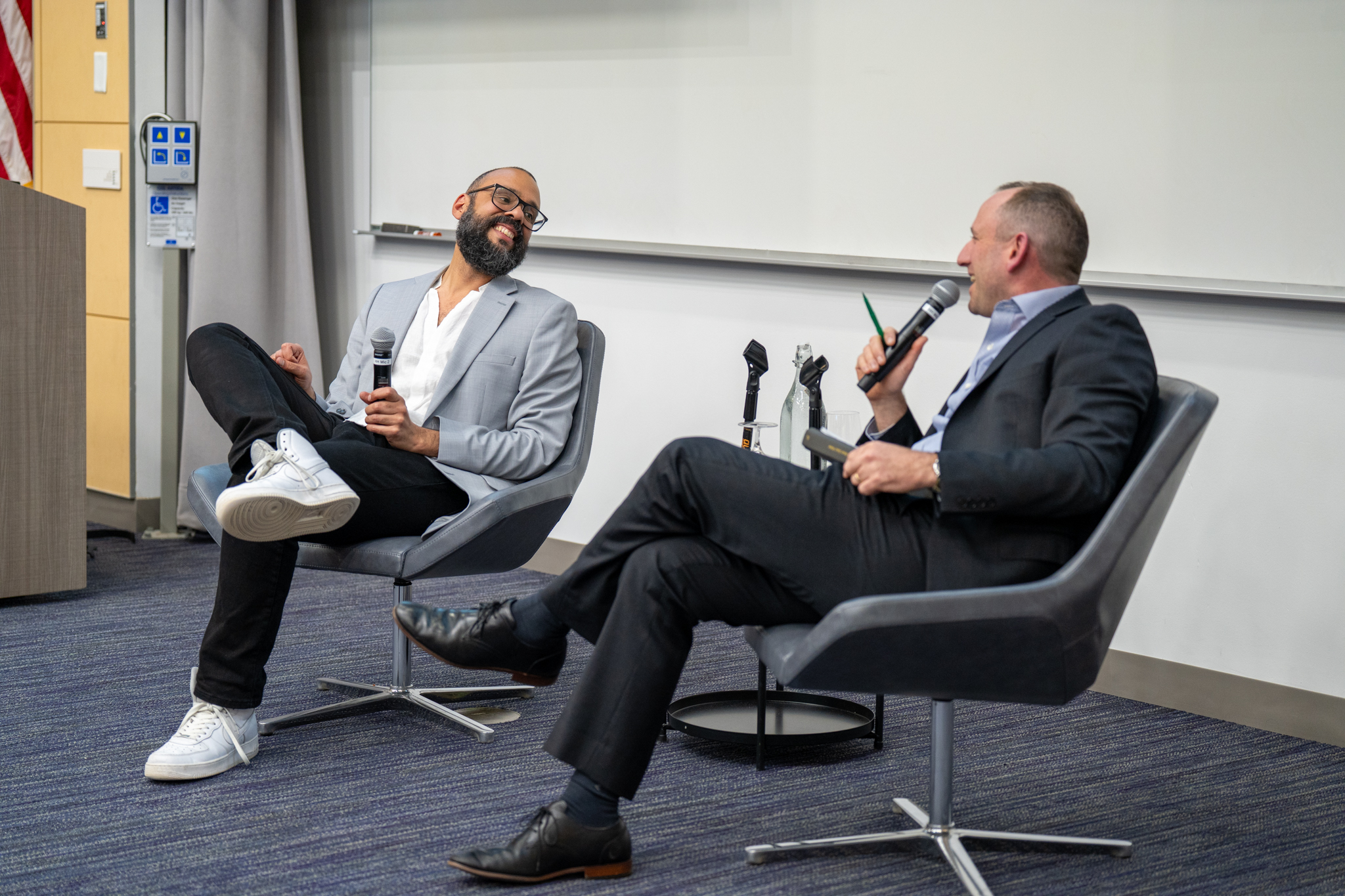
The Center hosted its first headliner event on November 12, 2025, featuring sociologist Musa al-Gharbi, Assistant Professor of Communication and Journalism at Stony Brook University. He is the author of We Have Never Been Woke: The Cultural Contradictions of a New Elite (Princeton University Press, 2024), a book that examines the relationship between contemporary elite culture, symbolic politics, and persistent inequality. The event was part of CEVIHE’s series on The Future of the American Left and Right.
Al-Gharbi opened by outlining the core argument of his book and introducing the social group at its center, which he terms “symbolic capitalists.” Symbolic capitalists, as he defined them, are individuals whose livelihoods depend primarily on manipulating symbols, ideas, and information—such as those working in academia, media, consulting, law, finance, and related knowledge professions—rather than producing physical goods or services. He emphasized that he includes himself in this category, noting that most college graduates ultimately enter these professions.
Drawing on large-scale empirical research, including an analysis of approximately 27 million news articles published over the past 50 years, al-Gharbi described recurring periods of intensified moral and political contestation that he refers to as “awokenings.” He argued that these episodes are marked by sudden spikes in elite discourse about prejudice and discrimination across multiple domains at once, particularly within media, academia, and allied institutions.
Al-Gharbi identified two conditions that consistently predict the emergence of these “awokenings”: acute elite overproduction and popular immiseration. Elite overproduction refers to a growing number of highly educated individuals who reasonably expect elite status but face increasingly constrained opportunities, while popular immiseration describes prolonged economic hardship among non-elites. When these dynamics coincide, he argued, symbolic capitalists are more likely to indict existing social orders in the name of justice and reform.
A central and unsettling conclusion of al-Gharbi’s research is that these periods rarely produce meaningful material benefits for the most disadvantaged members of society. As he put it during his talk, “what you don’t see in any of these periods of awokening [is] meaningful allocations of resources and opportunities from the wealthy in society to the genuinely marginalized and disadvantaged.” Instead, the most tangible gains often accrue to already-advantaged elites, sometimes in the form of new professional opportunities or symbolic recognition.
Al-Gharbi further argued that the rise of symbolic politics helps explain increasing political polarization and institutional mistrust. Contrary to common narratives, he maintained that recent polarization reflects less a rightward shift among conservatives than a rapid leftward shift among highly educated, affluent, and disproportionately white Democratic constituencies. These shifts, he suggested, have pulled major institutions and party platforms further from the median voter.
One consequence of these dynamics, according to al-Gharbi, is growing public support for right-aligned political entrepreneurs who campaign on promises to “bring institutions back under control.” Another is the creation of alternative knowledge-economy infrastructures—such as partisan media outlets or parallel intellectual institutions—that thrive on distrust of mainstream elites. These developments, he argued, further intensify polarization while weakening public confidence in institutions such as universities and the press.
Al-Gharbi also highlighted what he described as a recurring imbalance between symbolic and substantive change. Symbolic struggles over language, naming, and representation, he argued, often substitute for material reform. As he explained, “We focus on the symbolic struggle about what’s on the name, and we change the name, we declare victory, and we do our next culture war thing—meanwhile, the people who live in that community, nothing has changed for their children, for their children’s education, for their children’s life prospects.”
Following al-Gharbi’s presentation, Professor Eitan Hersh moderated a wide-ranging fireside chat and audience Q&A. The discussion explored al-Gharbi’s intellectual motivations, the role of higher education in shaping political culture, and the tension between sincere commitments to social justice and equally sincere aspirations to elite status. Al-Gharbi emphasized that these commitments are not necessarily cynical but are often in conflict, with elite self-interest frequently shaping how moral ideals are pursued.
The exchange that followed pressed several of these claims more closely. Participants questioned whether recent polarization can be attributed primarily to a leftward shift among highly educated elites, or whether structural economic changes and developments on the political right warrant greater explanatory weight. Others challenged the assertion that “awokenings” fail to produce meaningful redistribution, suggesting that certain policy reforms and institutional changes complicate the historical pattern he describes. There was also debate over whether symbolic recognition and material reform are necessarily in tension, and over how to interpret the relationship between professional ambition and genuine moral conviction.

This event recap was prepared by CEVIHE, with reporting support from Michael Onysko and photography by Chaanakya Seethala and Jack Smart.
You can watch the event recording here.