
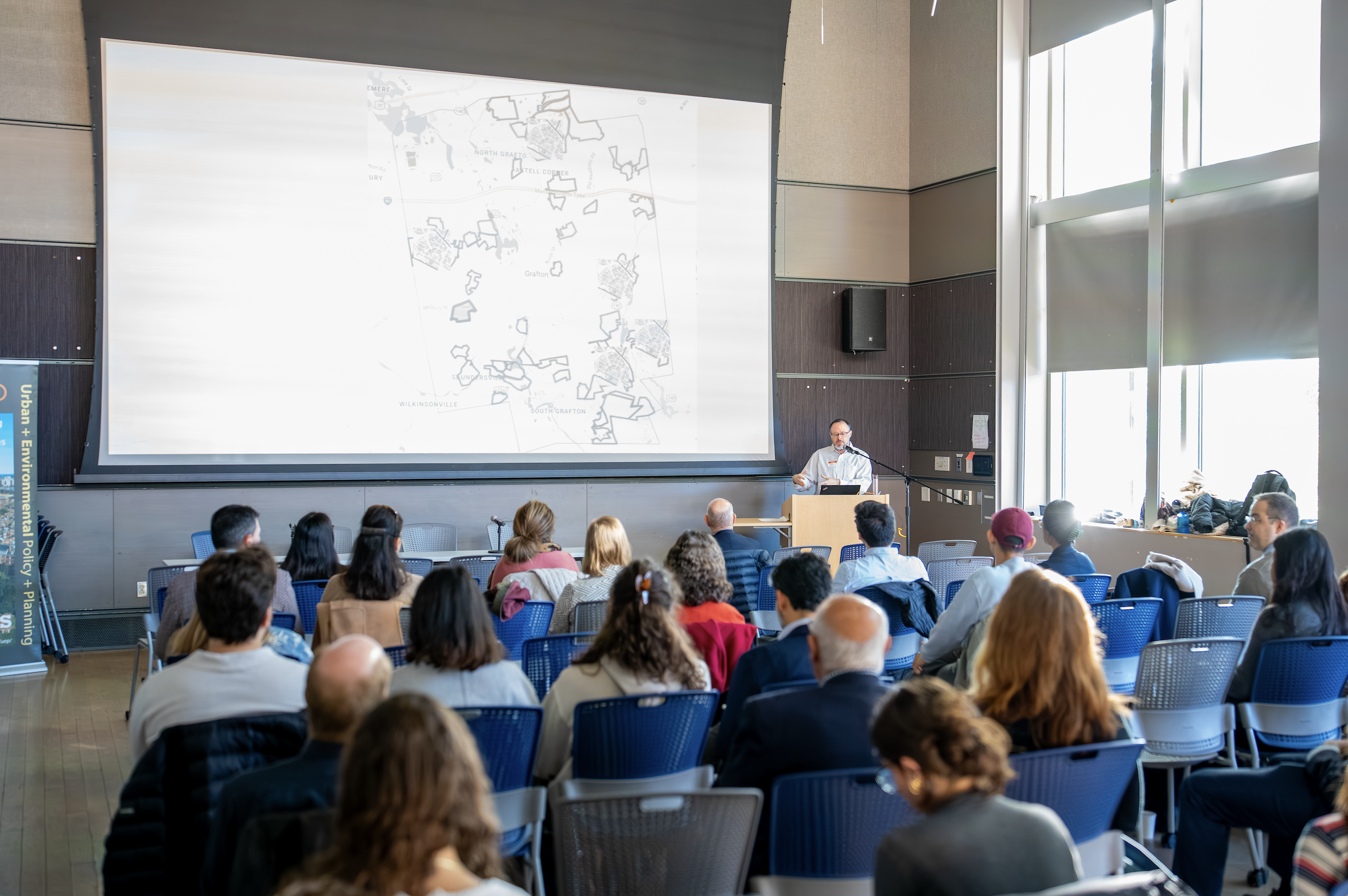
On October 17, 2025, CEVIHE co-sponsored Planning for New Towns: An International Symposium on Abundant Housing and Adaptive Zoning, a daylong gathering designed to stimulate rigorous discussion of innovative solutions to the ongoing housing crisis. The conference was organized by Justin Hollander, Professor of Urban Environmental Policy and Planning (UEP) and Director of the Urban Attitudes Lab at Tufts University. It was the Center’s first co-sponsored event.
The auditorium filled steadily as urban planners, architects, students, faculty, and policymakers gathered for a full day of debate about how to build housing differently—and whether starting from scratch might be easier than reforming what already exists. Bringing together policymakers, planners, researchers, and housing innovators from across the country, the symposium asked a timely and difficult question: if the United States has land, capital, and political will in certain regions, why is it still so hard to build affordable housing at scale?
The urgency of the housing crisis framed the day’s discussion. As cited during the symposium, data from the Harvard Joint Center for Housing Studies show that “Home prices grew by 43 percent between 2019 and 2022, while incomes grew by just seven percent in that same period.” The widening gap between wages and housing costs underscored the need for structural rather than incremental solutions. Much of the conversation centered on whether building entirely new communities could provide such a structural reset.
Jen Fox, Project Manager at California Forever, presented one of the most ambitious proposals: a master-planned city between Silicon Valley and Sacramento designed to house approximately 400,000 residents across 170,000 homes. Her presentation moved briskly between maps, infrastructure diagrams, and projected timelines, offering a tangible sense of what such a city might look like if built. The proposal prioritizes walkability, public transportation, and revised fire code standards to encourage biking and reduce car dependence. Fox described the city not as suburban sprawl but as a carefully integrated, mixed-use urban environment. Still, several attendees pressed her on whether the development could generate sufficient internal employment to avoid becoming a commuter enclave—an exchange that highlighted early tensions between design ambition and economic practicality.
Other speakers expanded the conversation beyond greenfield development. Some leaned toward adaptation rather than reinvention. Lincoln Lewis, Climate Equity Doctoral Fellow at the University of Virginia, drew on his experience contributing to new urban developments in Singapore. He discussed Bidadari, where multi-family housing is embedded within a “garden city” framework that integrates greenspace and density. Lewis’s examples suggested that increased housing supply need not sacrifice aesthetics or environmental integration.
In contrast, Nir Buras, Founder and Director of the Classic Planning Institute, challenged prevailing development patterns more directly. He argued that much contemporary housing reflects what he described as the “annihilation of beauty” in modern planning. Rather than embracing generic high-density forms, Buras advocated combining traditional architectural aesthetics with sustainable technologies. He suggested that long-term public support for new towns may depend not only on affordability but also on visual and cultural appeal.
Debate sharpened further around land use and scale. Here, the tone shifted noticeably, as competing assumptions about density and land availability surfaced more directly. Edward Pinto, Senior Fellow and Co-Director of the AEI Housing Center, questioned the emphasis on dense, multi-family housing in already developed areas. He argued that only a small fraction of the land in many states has been built upon, citing Florida as an example. Despite perceptions of overdevelopment, he noted that “Florida is not running out of land.” Pinto proposed creating “Freedom Cities” on underutilized Bureau of Land Management parcels in states such as Arizona and Nevada, allowing new municipalities to develop under streamlined, by-right zoning rules. In his view, building outward—rather than fighting regulatory battles in established urban cores—may offer a more politically feasible path to expanding supply.
That position drew contrast with other speakers who emphasized reforming existing systems rather than bypassing them. Ken Schwartz, Senior Vice President and Planning Service Leader at VHB, described his firm’s work redeveloping the former Creedmoor Psychiatric Hospital site in Queens in partnership with the New York State Government, a project expected to produce nearly 3,000 housing units. Schwartz emphasized what he called “integrated thinking…we need people who understand the real estate market and people who understand zoning changes.” His approach highlighted collaboration between public agencies and private firms rather than wholesale relocation to undeveloped land.
These differing strategies reflected deeper disagreements about governance. Pinto criticized decades of government inefficiency in housing delivery, while Schwartz and others argued that public-private partnerships are not the problem but the necessary vehicle for reform. Sepideh Azizi, reflecting on her upbringing in Iran, underscored how corruption and poor oversight can derail public housing projects. At the same time, she expressed cautious optimism that transparent collaboration in the United States could succeed where other systems had failed.
Research presented by Joseph Weil Huennekens grounded these philosophical disagreements in empirical findings. Examining housing developments in four suburban counties across New York and New Jersey, he found that approximately 1,000 units per year become tied up in litigation, compared to roughly 6,500 that are successfully built. “For every six units produced per year, one is litigated,” he noted, illustrating how legal barriers slow housing production regardless of design vision. His findings reinforced a recurring theme—regulatory and legal structures often determine outcomes more than architectural imagination.
The symposium closed with remarks from Jonathan Gruber, MIT Ford Professor of Economics and Department Head, who argued that rent control is not a viable long-term solution to rising housing costs. Instead, he emphasized supply expansion as essential to economic growth, stating that “housing is the fundamental bottleneck to growth in this country.” Gruber advocated building new communities near existing productive cities and technology hubs, describing such an approach as the “have your cake and eat it too” model. In this framework, proximity to economic opportunity and expanded housing supply could reinforce one another.
Throughout the day, disagreement did not undermine the conversation but animated it. At several points, speakers explicitly responded to one another, clarifying where they agreed and where their approaches diverged. Should the solution lie in reforming urban zoning or building entirely new municipalities? Should density be maximized within existing regions or expanded outward onto undeveloped land? Is the government the primary obstacle or the indispensable partner? Speakers diverged sharply on these questions yet converged on one point: the housing shortage is structural, not cyclical, and requires bold, politically durable responses.
Rather than offering a single blueprint, the New Towns Symposium illuminated the complexity of the crisis and the trade-offs embedded in each proposed solution. Whether through new towns, zoning reform, public-private redevelopment, or supply-side expansion near economic hubs, the conversation made clear that solving the housing crisis will require sustained institutional reform and political courage.

This event recap was prepared by CEVIHE, with reporting support from Elle Cutler and photography by Chaanakya Seethala.